
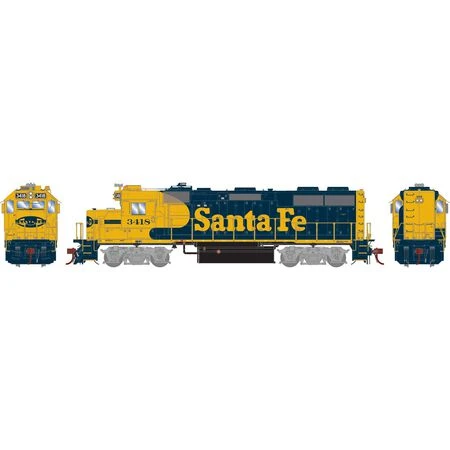
Athearn Genesis HO G66254 GP39-2u, Atchison Topeka And Santa Fe #3418
Original price was: $195.49.$97.99Current price is: $97.99.
- Secure Shopping with Safe Payments
- Unbeatable Quality, Unbeatable Value
- Fast, friendly, always here to help.
- The quality solution for all your needs.

Sensitivity to fuel economy in the 1970s justified the GP39-2 in the locomotive market. It also laid the ground work for EMD to start exploring locomotive designs that utilize engines with larger piston displacement yet possess fewer cylinders. This approach has become the foundation to modern locomotive technology.
ATSF FEATURES:
New Santa Fe phase 1 GP39-2u body with corrugated grilles – First time in Genesis!
Illuminated “Swing out” style number boards
Stratolight Beacon (effect in DCC)
Newly tooled exhaust stack
Removed class lights
“Switcher” style walkway steps
Rear mounted fuel tank
Large front anticlimber
Starting in 1986, Santa Fe rebuilt 50 GP39-2’s in their Cleburne, TX shops, designating them as “GP39-2u’s”. The “u” stood for “upgrade” which was a common term for Santa Fe rebuilds during this time. Other than the mechanical and electrical upgrades, Santa Fe added some unique details that distinguish these from their non-rebuild counterparts. These changes include: Fuel tank moved to the rear, new “swing out” style number boards, new style exhaust stack, and added an equipment door to the right side hood, just behind the cab. They also featured “switcher” style walkway steps for crew comfort during switching moves. A few even received modified corrugated radiator grilles.
ROAD NUMBER SPECIFIC FEATURES:
#3409/3415/3418
PH 1 body with chickenwire grilles
Leslie 3-chime horn
Added access equipment door behind cab
GP39-2 LOCOMOTIVE FEATURES:
Coupler cut levers
Trainline and MU hoses
Drop steps unless noted
MU stands
Windshield wipers
Lift rings
Wire grab irons
Walkway tread
Sanding lines
Lit number boards
Lit class lights, if equipped
Lit signal lights and/or beacons, if equipped
Bell placement & type per prototype
Detailed fuel tank with fuel fillers, fuel gauges, and breather pipes
Blomberg-B or Blomberg-M trucks with appropriate bearing caps
Speed recorder unless noted
See-through cab windows and full cab interior
Fine-scale Celcon handrails for scale appearance
Etched metal fan grilles
Air tanks mounted below sill unless noted
Body-mounted McHenry scale knuckle couplers – Kadee compatible
Scaled from prototype resources including drawings, field measurements, photographs, and more
Accurately painted and printed paint schemes
Genesis driveline with 5-pole skew wound motor, precision machined flywheels, and multi-link drivetrain
All-wheel drive with precision gears for smooth & quiet operation
All-wheel electrical pickup provides reliable current flow
Wheels with RP25 contours operate on all popular brands of track
LED Lighting for realistic appearance
Heavy die-cast frame for greater traction and more pulling power
Minimum radius: 18″
DCC-ready features Quick Plug plug-and-play technology with 21-pin NEM connector
Be the first to review “Athearn Genesis HO G66254 GP39-2u, Atchison Topeka And Santa Fe #3418”
Related products


HO Scale
Bachmann HO 73806 4-Bay Cylindrical Grain Hopper With FRED, Alberta “Visit Carstairs” #628311
Reviews
There are no reviews yet.