
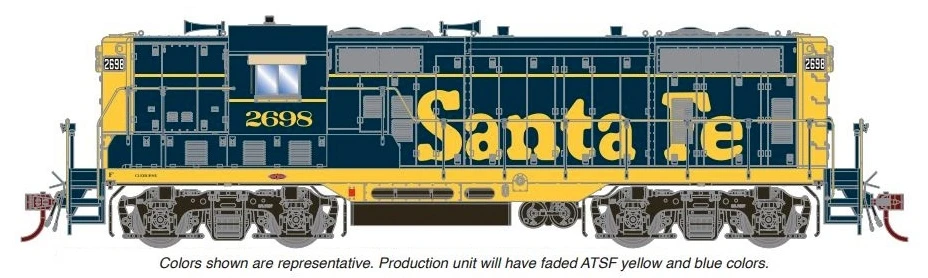
Athearn Genesis HO G82706 GP7, Atchison Topeka And Santa Fe #2698
Original price was: $280.49.$99.99Current price is: $99.99.
- Secure Shopping with Safe Payments
- Unbeatable Quality, Unbeatable Value
- Fast, friendly, always here to help.
- The quality solution for all your needs.

Primed for Grime
In 1949, EMD introduced the GP7. The basic design followed most diesel switchers with the addition of a short hood instead of an end-cab. The hoods were also full height to better accommodate the diesel engine and mechanical and electrical components. In 1954 EMD upgraded the GP7 to become the 1,750 horsepower GP9. Externally, the first GP9s were virtually unchanged from the last GP7s. Later versions would include different louver arrangements and the last ones would come without the frame skirting. The GP9 was available with all of the fuel tank, steam generator, and dynamic brake options as the GP7, including “torpedo tube” air tanks mounted on the roof. Many railroads chose to rebuild their GP7s and GP9s for continued service. Often times, it was cheaper to do this rather than purchasing brand-new locomotives.
Liking the performance of their EMD F units, Santa Fe wanted reliable road switchers that could provide better visibility and share components with their other EMD brethren. Between 1950 and 1953, they ordered 244 GP7’s. During the 1960s, Santa Fe started to repaint their fleet of GP7’s into a more simplified scheme to help on paint masking costs. They were the only purchaser of a small batch of GP7B’s, and were usually mated to a like road numbered A units. By the 1960s, they could be found running with other units in switching assignments. In the 1970s, the fleet of GP7’s would end up being rebuilt into “GP7u’s” with fully rebuilt cabs, electrical components, and prime movers. The B units received cabs in the process.
Since Santa Fe was known for changing out spark arrestors, we included them in a poly bag for the modeler to install to match your modeling era.
ROAD NUMBER SPECIFIC FEATURES:
#2698 Non-Dynamic brakes, late pre-rebuild faded version, removed foot boards, late coupler levers with notched pilots, “Can” antenna with stand right side of cab
#2742 Non-Dynamic brakes, repaint with yellow handrails and blue stanchions, full foot boards, “Can” antenna with stand left side of cab
#2819 Non-Dynamic brakes, repaint with blue handrails and yellow ends, full foot boards, “Can” antenna with stand left side of cab
#2791A B unit, Dynamic brakes, repaint with yellow handrails and blue stanchions, full foot boards
ATSF FEATURES:
Early Leslie dual “Blatt” style horns
Two different Santa Fe lettering styles
Correct parts placement per road number
ATSF spark arrestors provided in poly bag
Canvas sunshades
FEATURES:
Coupler cut levers
Trainline and MU hoses
Drop steps unless noted
MU stands
“Nub” style walkway tread
Windshield wiper
Lift rings
Wire grab irons
Windshield wipers
Sander lines
Bell placement & type per prototype
Detailed fuel tank with fuel fillers, fuel gauges, breather pipes, and retention tanks
Blomberg-B trucks with appropriate bearing caps
Speed recorder unless noted
See-through cab windows and full cab interior
Fine-scale Celcon handrails for scale appearance
Etched metal radiator intake grilles and fan grilles
Air tanks mounted below sill unless noted
Body-mounted McHenry scale knuckle couplers – Kadee compatible
DCC-ready features Quick Plug plug-and-play technology with 21-pin NEM connector
Scaled from prototype resources including drawings, field measurements, photographs, and more
Accurately painted and printed paint schemes
Genesis driveline with 5-pole skew wound motor, precision machined flywheels, and multi-link drivetrain
All-wheel drive with precision gears for smooth & quiet operation
All-wheel electrical pickup provides reliable current flow
Wheels with RP25 contours operate on all popular brands of track
LED Lighting for realistic appearance
Heavy die-cast frame for greater traction and more pulling power
Minimum radius: 18″
PRIMED FOR GRIME MODELS FEATURE:
Duplicated look and feel of “In Service” equipment
Faded base colors matched to the prototype
Perfect starting point for adding grime and rust
SOUND-EQUIPPED MODELS ALSO FEATURE:
Onboard DCC decoder with SoundTraxx Tsunami2 sound
Dual cube speakers for optimal sound quality
Sound units operate in both DC and DCC
Full DCC functions available when operated in DCC mode
Engine, horn, and bell sounds work in DC
All functions NMRA compatible in DCC mode
Precision slow speed control
Program a multiple unit (MU) lashup with lead unit only horn, bell, and lights
Many functions can be altered via Configuration Value (CV) changes
CV chart included in the box
Be the first to review “Athearn Genesis HO G82706 GP7, Atchison Topeka And Santa Fe #2698”
Related products


Reviews
There are no reviews yet.