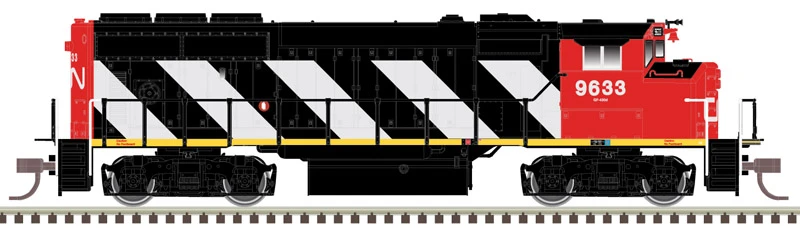
Atlas N 40004882 Gold Series GP40-2W, Canadian National (Zebra Stripes) #9644
Original price was: $220.96.$95.99Current price is: $95.99.
- Secure Shopping with Safe Payments
- Unbeatable Quality, Unbeatable Value
- Fast, friendly, always here to help.
- The quality solution for all your needs.

In 1973 Canadian National (CN) designed the safety cab, also known as the comfort cab, which featured a full-width nose that was intended to improve crew safety in the event of a collision. The first CN locomotives to feature this cab were GMDD GP38-2s and MLW M420s. GO Transit ordered the first safety cab equipped GP40-2s in 1973 with a three-unit order. CN then ordered their first safety cab GP40-2s from GMDD in 1974. Using CN’s locomotive classification system, these locomotives were assigned the designation GF-430 (General Motors, Freight, 4-axle, 3000hp). Letters are added after this designation to denote the separate orders for a given model.
The terminology “early” and “late” is used when referring to various road names on this run. “Late” CN and former CN units feature ditch lights, snow shields and have their air horn relocated to the top of the long hood.
FEATURES:
Long Hood Styles: CN (single light w/o number boards)
3,000 Gallon Fuel Tank
Will have properly operating ditch lights
Snow Shields
Round or Square Sand Fill Hatches
Cab-Mounted Bell
Three-Chime Air Horn Mounted on Cab or Long Hood
Etched Metal Sunshades (user installed)
Factory-installed AccuMate magnetic knuckle couplers
Blackened metal wheels
Scale Speed motor
SOUND FUNCTIONALITY FEATURES (GOLD MODELS ONLY):
Over 20 sound effects are available, including engine start-up and shutdown, prime mover sounds through all eight notches, bell, air horn, air compressor, dynamic brakes and more
Equipped with ESU’s Exclusive “Full Throttle” features for ultimate realism in prototype running
DCC OPERATION FEATURES:
Supports all DCC-programming modes
DCC includes RailCom and RailComPlus, with 14, 28 or 128 speed steps and with 2-digit and 4-digit addressing
Flexible mapping of function keys F0 to F28
A total of 6 DCC function outputs are available, and all can be function mapped (disable, brightness, light effects) individually
Follows all NMRA DCC standards and recommended practices
Be the first to review “Atlas N 40004882 Gold Series GP40-2W, Canadian National (Zebra Stripes) #9644”
Related products

Trains
Bachmann HO 14304 85′ Smoothside 3-2 Observation Car With Lighted Interior, Union Pacific #1575
Reviews
There are no reviews yet.